
 EN
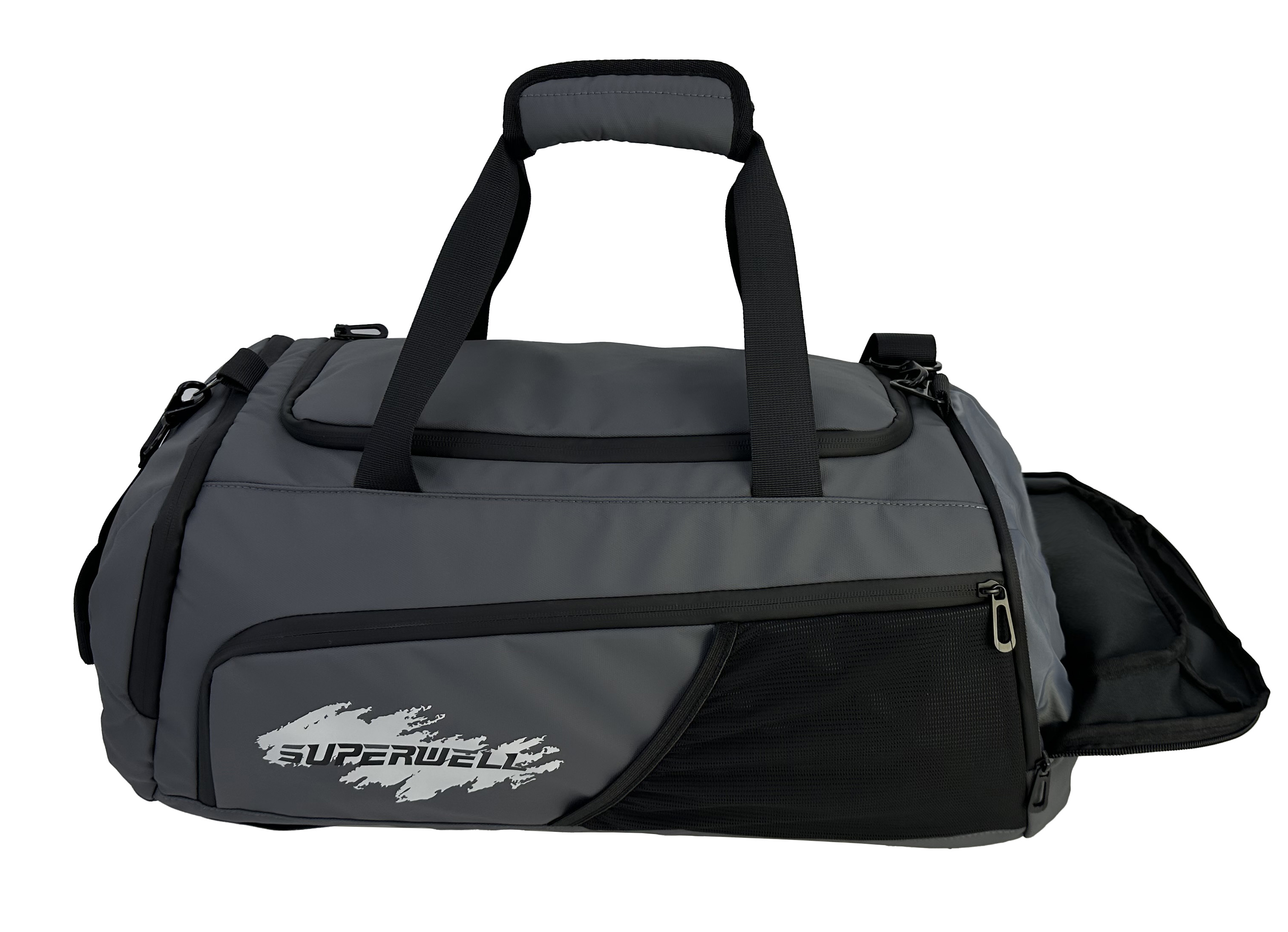
When global brands source collapsible luggage, ensuring that the hinges, fabric panels, and structural seams withstand repeated packing and unpacking is critical. At Superwell, conducting a rigorous folding cycle test for foldable travel duffle bag samples forms the backbone of our quality assurance pipeline. By simulating real-world consumer use over thousands of collapses and expansions, our engineering team validates whether a foldable travel duffle bag can endure years of frequent transit without premature fabric fatigue or zipper failure.
Understanding the Purpose of Folding Cycle Testing
A folding cycle test evaluates the mechanical resilience of luggage designed to collapse into an integrated pouch or a flat profile. Unlike standard rigid luggage, a foldable travel duffle bag experiences dynamic multi-directional stress along its designated fold lines, crease points, and zipper tracks.
During standard factory operations, running a folding cycle test helps quality inspectors identify weak bonding agents, improper stitching density, or substandard synthetic weaves before mass production begins. For B2B procurement managers, reviewing data from a folding cycle test provides tangible proof of product longevity, minimizing costly post-sale warranty claims and returns.
Laboratory Testing Standards and Equipment Setup
To maintain international credibility and alignment with 2026 manufacturing benchmarks, Superwell conducts every folding cycle test in accordance with recognized material endurance standards, incorporating principles from ASTM D3884 for abrasion resistance and ISO 13934 for fabric tensile strength.
The testing apparatus utilizes automated pneumatic actuators programmed to mimic human packing habits. The sample bag is securely mounted on a precision fixture. A mechanical arm then executes a synchronized sequence of folding along the pre-engineered crease lines, compressing the bag into its storage pocket and subsequently deploying it back to full volume.
Step-by-Step Testing Procedure
-
Conditioning Phase: Sample bags undergo pre-conditioning in a controlled climate chamber (20 degrees Celsius and 65 percent relative humidity for 24 hours) to stabilize nylon, polyester, and TPU laminate fabrics.
-
Initial Inspection: Technicians record baseline metrics, checking zipper smoothness, seam integrity, and fabric weight.
-
Automated Cycling: The pneumatic testing rig initiates the folding cycle test, running continuous repetitions at a controlled velocity of 15 cycles per minute.
-
Intermediate Audits: At pre-set milestones (e.g., 500, 1,000, and 2,500 cycles), the testing pauses to inspect for thread fraying, coating delamination, or micro-cracks in waterproof membranes.
-
Final Stress Evaluation: Once the target threshold (typically 3,000 to 5,000 cycles for premium travel lines) is reached, the sample undergoes a final burst pressure and pull test.
Comparative Parameters for Folding Durability
To give procurement teams a clear view of how different material specifications perform under stress, the following comparison table outlines our benchmark criteria during a standard folding cycle test.
| Material Spec | Coating Type | Target Folding Cycles | Failure Threshold Observed | Common Mitigation Strategy |
|
210D Ripstop Nylon |
PU Coated |
1,500 Cycles |
Minor edge fraying at pocket seams |
Add bar-tack reinforcement at stress points |
|
400D Polyester |
TPU Laminated |
3,000 Cycles |
Delamination along sharp crease folds |
Optimize crease radius during pattern grading |
|
600D Oxford Fabric |
PVC Backed |
5,000+ Cycles |
Stiffening and cracking in cold environment |
Switch to cold-crack resistant elastomer blends |
Engineering Insights and Defect Prevention
Conducting a folding cycle test often uncovers subtle design flaws that can be corrected early in the prototyping stage. For instance, if a folding cycle test reveals coating cracking along the bottom base panel, our R&D team modifies the panel geometry by introducing a rounded radius rather than a sharp 90-degree corner.
Furthermore, zipper teeth alignment plays a massive role in cycle endurance. If a duffle bag features a wrap-around zipper that acts as the primary hinge during collapse, misaligned teeth will jam or shear off before reaching 1,000 cycles. By reinforcing zipper tape with double-needle stitching and high-tensile polyester thread, we ensure the folding cycle test passes with flying colors.
Conclusion and Supply Chain Assurance
Integrating a strict folding cycle test into your product development lifecycle guarantees that your brand delivers reliable, long-lasting gear to end-users. At Superwell, our commitment to transparent quality control ensures every foldable travel duffle bag meets rigorous international benchmarks.
For more details on our material sourcing or to request customized sample testing for your next product line, visit our main guide or reach out to our engineering team today.