
 EN

Trolley Bag Customization: What to Spec Before You Approve a Sample?
before a custom trolley bag goes to sampling, lock six things in writing — trolley tube spec and stages, wheel type and durometer, base-plate load path, fabric and coating with test targets, dimensions against your airline envelope, and the compliance file for your market. Most failures on wheeled bags are not fabric failures but interface failures: where a 20 kg load moves from the bag body into a 1.2 mm aluminium tube, then into a 60 mm wheel.
Write the telescopic handle like a mechanical part
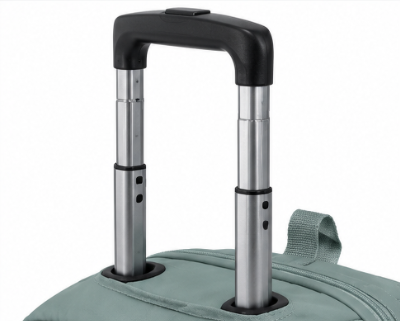
"Aluminium trolley" is not a specification. State the alloy (6061 or 7005), outside diameter (12–16 mm), wall thickness (0.8–1.2 mm — thinner dents at the handle root), stage count (two for carry-on, three for taller users, and it changes carton CBM), lock type, and lateral play at full extension, capped at 3 mm. That tolerance, set by bushing quality, is what makes a bag feel solid rather than rattly. Require 3,000 extension cycles under 15 kg.
Choose wheels against the floor, not the photo
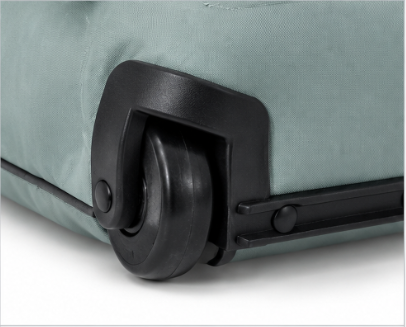
Two inline PU wheels at 60–76 mm roll over kerbs and cobblestones; four spinner casters stand and glide but fail fast on rough pavement, where the housing is the weak point. Specify PU at 82–85 Shore A — soft compounds flat-spot within a season — ABEC-5 bearings, and screw-fixed rather than riveted housings if your market expects after-sales. Test 5,000–10,000 rolling cycles at rated load, then check flat-spot depth (≤1 mm) and housing cracks.
Fix the load path through the base plate
The base plate carries the bag, not the trolley. Specify PP or PE board thickness (2–3 mm), or glass-filled nylon for 25 kg+, the fixing method, bar-tacks at every anchor, and a rated load in kilograms tested statically and dynamically. "Strong" with no kg figure means no engineering.
Lock fabric, coating and test targets together
600D polyester with PU 1,000 mm backing is the workhorse; 900D–1680D for utility trolleys; GRS-certified RPET if you sell recycled content. Pair it with lab targets: Martindale 20,000+ cycles, tongue tear to ASTM D2261, rubbing fastness grade 4, and AATCC 127 hydrostatic if you claim water resistance. Match the care label: "wipe clean" and "machine washable" need different seams.
Size to the airline, not the drawing
Design to the tightest carrier you will advertise, measured with wheels and handle extended, ±5 mm. A 2 cm overrun turns a listing into refund requests.
Build the compliance file at sampling
For the EU: REACH SVHC screening against the current candidate list, Annex XVII restrictions (azo dyes, nickel release, phthalates), and the GPSR technical file with risk assessment, traceability and an EU responsible person — GPSR has applied since 13 December 2024. Recycled claims need a GRS scope certificate plus transaction certificates for the lot, and since 27 September 2026 unsubstantiated "eco-friendly" claims are no longer defensible under Directive (EU) 2024/825.
Settle branding, MOQ and spares before price
Decide the logo method early — embroidery, silicone patch, metal badge, debossed PU, or laser engraving on the tube — because moulds run 15–35 days. Give Pantone references correctly (TCX for textiles, C for print and moulded parts) and approve dips under D65 at ΔE ≤ 1.5. Ask for stock-colour and custom-colour MOQ tiers, plus three after-sales answers: spare-parts kit (1–2% of order), warranty coverage, and tooling ownership.