
 EN

7 Places a Commuter Backpack Wears Out First — and the Fixes That Prevent It
a commuter backpack rarely fails in the middle of a panel. It fails at seven predictable stress points — strap anchors, base panel, main zipper, laptop sleeve, back foam, top handle, and hardware. Each has a known construction fix, and each fix costs less at sampling than in warranty claims later.
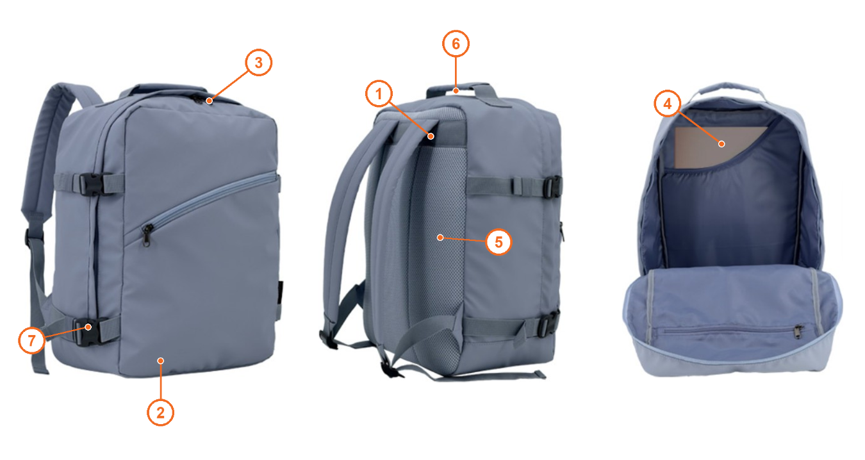
1. Shoulder strap anchors
A loaded commuter bag puts 5–9 kg on two strips of webbing. The stitching joining those straps to the body takes that load every time the bag is lifted or swung onto a shoulder. Typical failure: the bar-tack pulls through the lining, or the webbing frays where it enters the bag.
The fix: anchor the straps into a load-bearing panel rather than the lining alone, back the junction with 600D–1680D fabric, and secure it with a box-X stitch plus a second bar-tack.
2. The base panel
The bottom meets concrete, train floors and puddles several times a day. It abrades at the corners first, then wicks water through the seam.
The fix: use a heavier denier at the base than the body (600D–900D polyester or 1680D ballistic nylon), reinforce both bottom corners with PU or Hypalon patches, and bind the base seam instead of leaving it raw. A slightly raised base keeps fabric off wet ground.
3. The main zipper
Coil zippers split at curves, sliders lose tension, and tape peels from the shell.
The fix: use a #8 or #10 coil for the main compartment, set the zipper into a gusset so load presses on the tape rather than the teeth, and specify branded sliders with locking pulls. Storm flaps and zipper garages keep rain and grit out. On roll-top commuter styles, a buckle-and-webbing closure removes the long curved zipper entirely.
4. The laptop sleeve
Laptops die from corner impacts, and sleeves fail when foam compresses to nothing or there is no false bottom, so the device rests directly on the bag's base.
The fix: a suspended false bottom 20–30 mm above the base, 8–10 mm EVA or PE foam on all four sides, a brushed lining, and a hook-and-loop security strap. Drop-test the finished bag with a dummy load, not the sleeve alone.
5. Back panel and strap foam
Cheap foam flattens within a season, and glued airmesh delaminates in humid weather. The bag then feels heavier than it is.
The fix: molded 3D airmesh over perforated EVA rather than flat laminated foam, plus a channeled back panel for airflow. On recycled programs the same construction runs in GRS-certified rPET, as specified in Superwell's R-PET commuter range.
6. The top handle
People lift a fully loaded bag by the handle with one hand. If the handle is stitched only to the top edge, it tears out at the ends.
The fix: run the handle webbing down the body and wrap it into the side seams, so load transfers to the panel rather than the top edge. Bar-tack both ends and pad the grip.
7. Hardware and trim
Acetal buckles crack in cold, adjusters slip under load, edge binding abrades, and heat-transfer reflective strips peel after repeated washing.
The fix: POM hardware with UV stabilizers rated for low-temperature flex, metal or locking-cam adjusters at load points, PU-coated binding on high-friction edges, and reflective elements that are sewn or bonded rather than only heat-pressed.
What to put on the specification sheet
|
Component |
Specification to request |
|
Strap anchor |
Box-X + bar-tack, backed by 600D+ panel |
|
Base |
600D–900D polyester, corner patches, bound seam |
|
Main zipper |
#8–#10 coil, branded slider, storm flap |
|
Laptop sleeve |
False bottom + 8–10 mm EVA, drop-tested |
|
Back system |
Molded 3D mesh over perforated EVA |
|
Hardware |
POM with UV stabilizer, load-tested adjusters |
【FAQ 】
How long should a commuter backpack last with daily use?
Three to five years is realistic for a well-built bag. Most bags retired earlier fail at an anchor or zipper, not because the shell wore through.
Can these fixes be added to an existing design?
Yes. Reinforcement changes are usually pattern-level edits, applicable through OEM revision rather than a full redesign. New ODM development builds them in from the first sample.
Does heavier fabric always mean a stronger bag?
No. A 1680D base under a strap anchor stitched only to lining will still fail. Construction at the junction matters more than denier.
How do I validate the build before bulk production?
Ask for the sample to be load-tested at the strap anchors, drop-tested with a weighted laptop, and cycled on the main zipper. Quanzhou Superwell runs these checks at sampling, with design drawings in 1–3 working days and pre-production samples in 5–7.
Build the weak points out, not the warranty claims in.
Commuter bags are judged in year two, not on the showroom shelf. Send us your current style or tech pack and we will map these seven points against your construction before you commit to tooling.